

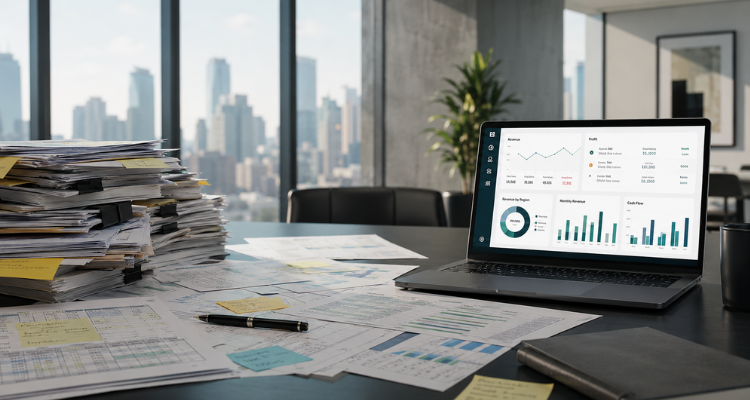
Every growing business has that one spreadsheet.
The master file.
The one someone created years ago, added a few formulas to, shared with the team, protected a few cells, forgot the password, and now everyone is slightly scared to touch it.
It probably started as a smart fix. A sales sheet here. A stock sheet there. A purchase tracker. A payroll file. A report for management. Nothing wrong with that. Spreadsheets are useful, especially when a business is small and the team can manage things manually.
But the problem starts when spreadsheets become the backbone of the business.
One wrong entry, one deleted formula, one outdated version sent on WhatsApp, and suddenly no one is sure what is correct anymore.
If your company is growing and your operations still depend on spreadsheets held together by habit, memory, and a little bit of luck, it may be time to consider proper erp software.
Here are seven signs your business has outgrown spreadsheets and what you can do next.
1. You Re-Enter the Same Data in Multiple Places
This is one of the first signs.
A customer order comes in, and someone enters it in the sales sheet. Then the same details go into the inventory sheet. Then finance enters the invoice details again. Later, someone adds it to a dispatch tracker.
Same customer. Same order. Same numbers.
Four different places.
At first, this may not feel like a huge problem. But as the business grows, repeated data entry creates delays and mistakes. A wrong quantity in one file. A customer name spelled differently in another. A price updated in one sheet but not the other.
Small errors start spreading quietly.
This is where an erp system makes a real difference. Instead of entering the same data again and again, one entry flows through the right departments. Sales, inventory, purchase, finance, and management all work from the same information.
For example, when a sales order is created in a proper erp software in pakistan, it can automatically affect stock availability, invoice creation, delivery planning, and reporting. No chasing five files. No asking, “Which sheet is final?”
That alone saves hours every week.
2. Reports Take Days, Not Minutes
You ask for a sales report on Monday.
By Wednesday, someone is still collecting data.
Finance needs numbers from sales. Sales needs updated dispatch details. Inventory has a separate file. Purchases are in another folder. Then someone has to clean the data, remove duplicate entries, fix formulas, and create a final version for management.
And even then, someone asks, “Are these figures updated?”
This is a big warning sign.
When reports take days, management ends up making decisions based on old information. By the time the report is ready, the situation may have already changed.
A proper erp solution gives you live dashboards and reports. You can check sales, stock, expenses, receivables, payables, purchases, and profit without waiting for someone to manually prepare everything.
For a business owner, this matters. You should not have to wait three days to know which product is selling, which customer has overdue payments, or which branch is low on stock.
Good reporting is not just about neat charts. It is about making decisions while they still matter.
3. Stock Counts Never Match the System
This one is painfully common.
The sheet says 250 units are available.
The warehouse says only 180 are there.
Sales already promised 220 to a customer.
Now everyone is checking old entries, delivery notes, purchase receipts, returns, damages, and transfers to find out what happened.
Sound familiar?
Inventory is one of the first areas where spreadsheets start breaking down. Manual stock tracking may work when you have a small number of products, one store, and limited daily movement. But once your business starts handling multiple items, branches, warehouses, batches, or frequent dispatches, spreadsheets become risky.
For retail, distribution, manufacturing, food, chemical, pharma, and textile businesses, stock accuracy is not optional. It affects cash flow, production, delivery timelines, and customer trust.
With an erp system, inventory updates happen as transactions happen. Purchase receipts increase stock. Sales deliveries reduce stock. Transfers move stock between warehouses. Adjustments are recorded with proper approval.
If you are dealing with manufacturing or distribution, the right ERP can also help with manufacturing inventory software, batch tracking, expiry tracking, warehouse control, and reorder planning.
That means fewer surprises when a customer places an order.
4. Departments Work in Silos
In many growing businesses, every department has its own “system.”
Sales has a spreadsheet.
Finance has accounting files.
Inventory has stock sheets.
HR has attendance records.
Purchase has vendor files.
Management gets final reports once everything is manually combined.
Everyone is working, but not really together.
This creates silos.
Sales may not know a customer has unpaid invoices. Inventory may not know a large order is coming. Finance may not know a purchase has already been approved. Management may not see a problem until it has already become expensive.
This is where businesses start searching for business automation software pakistan because they need departments to connect.
An ERP brings departments into one workflow. Sales orders, purchase requests, approvals, invoices, payments, stock updates, and reports are connected. People still do their own jobs, but the information moves properly.
For example, if sales creates an order, finance can check the customer’s credit status. Inventory can check stock. Purchase can plan material if stock is low. Management can see the order value in reports.
No separate chasing. No guessing.
5. You Cannot See Real-Time Profit
Revenue is easy to see.
Profit is harder.
A business may be making good sales but still struggling because costs are not visible in real time. Purchase prices change. Discounts are given. Stock is wasted. Production costs increase. Expenses are recorded late. Customer payments are delayed.
If everything is handled on spreadsheets, it becomes difficult to know the real picture.
You may know how much you sold last month, but do you know which product had the best margin? Which customer gives you profit and which one only gives volume? Which branch is performing well after expenses? Which production batch cost more than expected?
That is the kind of visibility a growing business needs.
A good erp software helps connect sales, purchase, inventory, accounting, and expenses. This makes profit tracking more realistic.
For businesses in Pakistan, this is especially important because costs can move quickly. Raw materials, transport, currency changes, supplier rates, utility bills, and staff costs all affect margins.
If your spreadsheet only shows sales but not real profit, you are looking at half the story.
6. Growth Is Creating Chaos, Not Control
Growth should feel exciting.
More orders. More customers. More staff. More branches. More products.
But sometimes growth starts creating stress instead of control.
You hire more people, but mistakes increase. Sales grow, but delivery delays become common. Stock increases, but visibility becomes weaker. More customers come in, but follow-ups become messy. More reports are needed, but nobody has time to prepare them.
That is usually when the business has outgrown manual systems.
Spreadsheets are flexible, but they do not manage processes well at scale. They do not enforce approvals properly. They do not give strong user access control. They do not create automatic workflows. They do not alert teams when something is delayed.
This is why companies start looking for the best erp software in pakistan when they reach a certain stage of growth.
The goal is not to make the business more complicated. The goal is to bring structure before things become harder to control.
A proper ERP setup can help with:
Sales tracking
Inventory management
Purchase approvals
Accounting workflows
HR and payroll
Production planning
Customer records
Management reporting
And when done properly, it reduces daily confusion instead of adding more work.
7. Errors Are Costing Real Money
Spreadsheet mistakes can look small at first.
A wrong price.
A missed payment follow-up.
A duplicate entry.
An old stock figure.
A formula that stopped working.
A purchase approved without checking inventory.
A delivery sent to the wrong customer.
But these mistakes cost money.
Sometimes directly. Sometimes quietly.
A wrong stock count can delay an order. A missed receivable can affect cash flow. A wrong production quantity can waste material. A manual invoice error can upset a customer. A lost file can waste hours of staff time.
The bigger your business gets, the more expensive these mistakes become.
This is where working with an erp consultant pakistan can help. A good consultant does not just install software. They study your workflows, find weak points, and suggest the right system structure.
An experienced erp implementation company pakistan can help you move from scattered spreadsheets to a proper ERP without turning your operations upside down.
What to Do Next: Moving Off Spreadsheets Without Disruption
Now, the big question.
How do you move away from spreadsheets without creating panic in the company?
The answer is to do it step by step.
You do not need to replace everything overnight. In most cases, that creates more stress than progress.
Start With the Most Painful Area
Look at where spreadsheets are causing the biggest damage.
Is it inventory?
Sales tracking?
Accounting?
Production?
Purchasing?
HR and payroll?
Customer follow-ups?
Start there.
For many Pakistani businesses, inventory and finance are the first areas to fix because they directly affect cash flow and decision-making.
Clean Your Existing Data
Before moving to ERP, clean your existing spreadsheet data.
Remove duplicate customers. Fix product names. Check opening stock. Review vendor lists. Confirm account balances. Standardize item codes where possible.
Messy data in a spreadsheet becomes messy data in ERP if nobody reviews it.
Choose the Right ERP System
Not every business needs the same ERP.
Some companies need ERPNext. Some need Odoo. Some need custom workflows. Some need stronger inventory. Some need POS. Some need manufacturing. Some need accounting and reporting first.
This is why it helps to compare erp software price in pakistan based on your actual business requirements, not just a general package.
The cheapest system is not always the best choice. The most expensive one is not always the right one either.
Train Your Team Properly
ERP adoption depends on people.
Your team should know exactly how to use the system for their daily tasks. Warehouse users do not need the same training as accountants. Sales teams do not need the same training as purchase managers.
Good training reduces resistance.
And honestly, most staff members do not hate ERP. They hate unclear systems, rushed training, and software that does not match their work.
Move in Phases
A phased approach works better for most growing businesses.
You can start with core modules like accounting, inventory, sales, and purchase. Then add manufacturing, HR, payroll, CRM, or reporting as needed.
This keeps the business running while the system improves.
When Spreadsheets Stop Helping
Spreadsheets are not the enemy.
They help businesses start, organize, test ideas, and manage small workflows. But at some point, they stop supporting growth and start slowing it down.
If your team is re-entering the same data, waiting days for reports, arguing over stock figures, working in silos, or losing money through manual errors, it may be time to move toward proper erp solutions.
HM Technologies helps Pakistani businesses move from scattered spreadsheets to organized ERP systems using ERPNext, Odoo, and custom ERP implementation.
If your business is ready for more control, better visibility, and fewer daily follow-ups, take the next step.
Book a free ERP assessment with HM Technologies and find out which ERP setup fits your business best.
Related Posts

October 29, 2026
Managing Residential Communities: Common Problems an ERP Can Solve
Every industry faces its own operational challenges. Basic software may not meet every organization’s needs.…

October 20, 2026
How Hospital Management Software Improves Patient Record Management
In many hospitals, daily work slows down because of outdated record-keeping methods. Patient information may…

October 13, 2026
How ERP Software Helps Businesses Track Product Costs and Profit Margins
Imagine running a busy store or manufacturing unit where sales look strong every day, but…

October 6, 2026
School Management System in Pakistan: 8 Features Schools Actually Need in 2026
A school may technically have student records, fee records and exam records. If each department…